April 5, 2026
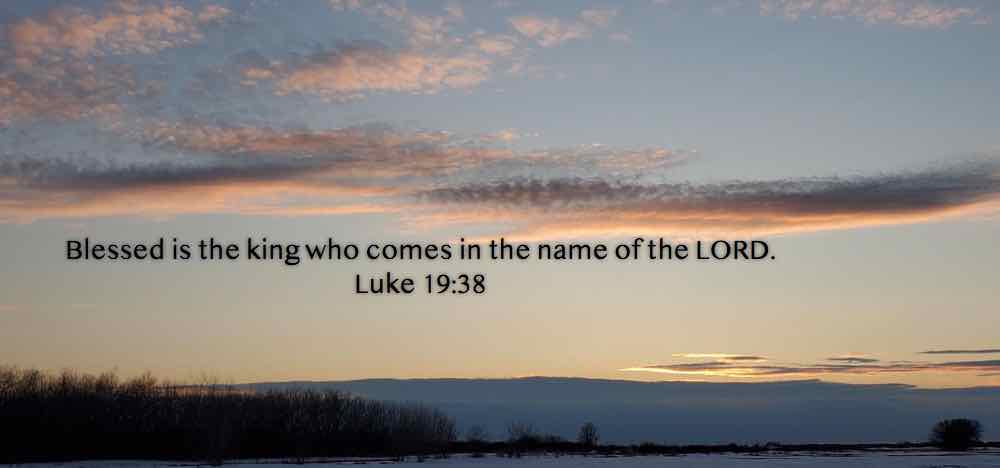
And when he had said these things, he went on ahead, going up to Jerusalem. When he drew near to Bethphage and Bethany, at the mount that is called Olivet, he sent two of the disciples, saying, “Go into the village in front of you, where on entering you will find a colt tied, on which no one has ever yet sat. Untie it and bring it here. If anyone asks you, ‘Why are you untying it?’ you shall say this: ‘The Lord has need of it.’ ” So those who were sent went away and found it just as he had told them. And as they were untying the colt, its owners said to them, “Why are you untying the colt?” And they said, “The Lord has need of it.” And they brought it to Jesus, and throwing their cloaks on the colt, they set Jesus on it. And as he rode along, they spread their cloaks on the road. As he was drawing near—already on the way down the Mount of Olives—the whole multitude of his disciples began to rejoice and praise God with a loud voice for all the mighty works that they had seen, saying, “Blessed is the King who comes in the name of the Lord! Peace in heaven and glory in the highest!” And some of the Pharisees in the crowd said to him, “Teacher, rebuke your disciples.” He answered, “I tell you, if these were silent, the very stones would cry out.”
Discussion Questions:
1) What is the significance of Jesus riding that animal into Jerusalem?
2) What is the significance of the phrase that the disciples cried out?
3) What is the significance of Jesus refusing to rebuke them?
Discussion Summary:
Throughout this account there are references to various prophecies of the old testament. In fulfilling these prophecies, Jesus is pointing to theological reasons for his actions. He rides a donkey into Jerusalem in fulfillment of Zechariah 9:9-10. In that prophecy the king of Israel is shown in his dual role. He is not only victorious and righteous but he is also lowly and humble as shown by his choice of animal.
The phrase “Blessed is the king who comes in the name of the Lord” is taken from Psalm 118:20-27. This psalm also includes the imagery of the stone which the builders reject becoming the chief cornerstone. With this phrase the disciples are perhaps even unknowingly to themselves pointing to the sad fact that Jesus will be rejected by the populace of the city.
The old testament prophecies concerning the Messiah had to be fulfilled by Jesus. Jesus had to be presented to the nation as its King. Even though the religious leaders rejected him, his disciples welcomed him into the city in this role. If they did not do this, Jesus says that the very stones of Jerusalem – the city which had been constructed as the place to praise God – would have made this declaration that he was king (Psalm 122:3,4). “Jerusalem – built as a city that is bound firmly together. to which the tribes go up, the tribes of the LORD, as was decreed for Israel, to give thanks to the name of the LORD.”
Leave a Reply